The Medicare population is the one US health policy most wants to reach with wearables. HHS has said it wants a wearable on every American within four years [1]. CMS started paying for technology-supported chronic care in July [2]. Nearly every Medicare Advantage plan offers a fitness benefit [3]. And the population those programs are aimed at is the one least likely to wear a device.
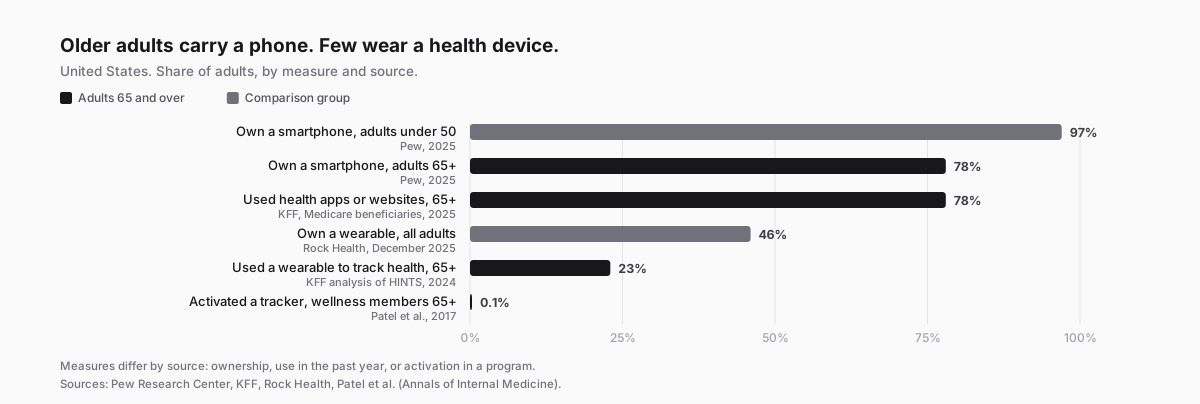
That is not because older adults avoid technology. Most of them carry a smartphone. The gap is specific to wearables, it is large, and it shapes what any program for older adults can actually measure.
The gap in numbers
| Measure | Adults 65 and over | Comparison |
|---|---|---|
| Own a smartphone, 2025 | 78% | 97% under 50; 90% aged 50 to 64 [4] |
| Used a wearable to track health in the past year, 2024 | 23% | 46% of all US adults own a wearable [5][6] |
| Own a wearable, adults 50 and over | 36% to 38% | The one device category where adults 50 and over trail younger adults [7] |
| Activated an activity tracker in a national wellness program | 0.1% | 90% of those who activated were still using it at six months [8] |
| Used health apps or websites in the past year, Medicare beneficiaries 65 and over | 78% | 58% say the tools make managing health easier [5] |
| Would share wearable data with a provider, among older wearable users | 85% | [5] |
Read across the rows and the picture is clear. Older adults use phones and health apps at high rates. They are willing to share health data with their doctors. What they do not do, for the most part, is wear a health-tracking device. The gap between smartphone ownership and wearable use among adults 65 and over is more than 50 percentage points.
The ownership data understates the gap for health programs in one respect. Rock Health describes US wearable owners as younger, wealthier, more urban, healthier and more likely to be commercially insured than non-owners [6]. Older adults with the lowest incomes, in rural areas and with the most chronic illness are the least likely to own a device. They are also the population most Medicare programs are designed for. We traced the same pattern across the whole market in the wearable market is splitting in two.
Why the gap exists
Starting is the barrier, not continuing. The most striking result in the literature is Patel and colleagues’ national sample: only 0.1% of wellness program members over 65 activated an activity tracker, yet 90% of those who did kept using it for six months, a higher rate than younger members [8]. Older adults who get past set-up tend to stay. We looked at this pattern across all ages in how many people still wear their wearable after six months.
Devices are designed for someone else. Reviews of adoption among older adults consistently cite usability built for younger users, small screens and controls, the burden of frequent charging, cost, uncertainty about what the data is for, and concerns about who sees it [9][10]. Older adults who feel they have enough support and knowledge are more likely to adopt and keep using devices [10].
The value proposition is a young one. Most wearables sell training load, recovery and sleep optimisation. For many older adults the relevant uses are different: fall detection, which Apple turns on automatically for users 55 and over [11], irregular rhythm and sleep apnea notifications, medication and appointment adherence, and sharing data with a clinician or family member.
The accuracy problem nobody mentions
Even when older adults do wear a device, the numbers are less reliable for them.
Step counts undercount slow and assisted walking. In a study of 42 adults aged 51 to 80, an Apple Watch undercounted steps by 36.4% when participants walked with a rolling walker and by 16.3% on a treadmill at 1.61 km/h. The authors concluded wrist-worn monitors may be unsuitable for people using assistive devices, and that waist-mounted devices were more reliable [12]. Earlier research found step counters undercounted by up to 31.2% at gait speeds below 0.8 metres per second, and that ankle-worn devices counted slow steps within about 5% [13]. We compared phone and wrist counting in general in step counting accuracy, phone versus wrist.
Validation studies rarely include older adults. A 2026 scoping review of 186 validation studies of consumer PPG wearables found the median share of participants aged 65 and over was 0% [14]. The heart rate, HRV and sleep algorithms in consumer devices were mostly validated on younger people. We found the same gap for skin tone in do wearables work on darker skin.
For a program that rewards a step target, the combination is harsh. The members most likely to use a walker or walk slowly are the ones whose steps are most undercounted, and a fixed target penalises them twice.
What Medicare is paying for now
| Mechanism | What it does for wearables | Source |
|---|---|---|
| Medicare Advantage supplemental benefits | 95% of enrollees in plans with a fitness benefit in 2026; 44% in plans offering remote access technologies, which may include devices | KFF [3][5] |
| Plan-specific device benefits | Essence Healthcare gives eligible members an Oura Ring and membership at no cost | Essence [15] |
| ACCESS model, from 1 July 2026 | Pays outcome-aligned amounts for chronic conditions; 190 participants accepted; about 70% of beneficiaries have a qualifying condition; $15 supplement per rural beneficiary toward connected device distribution | CMS, KFF [2][5] |
| 2026 remote monitoring codes | CPT 99445 pays device supply for 2 to 15 days of data in 30 days, lowering the bar that previously required 16 | CMS fee schedule [16] |
| Traditional Medicare | Does not cover consumer wearables | KFF [5] |
None of these buys a wearable for the typical beneficiary. The ACCESS model pays for outcomes, measured with validated devices and clinical tests, and leaves device choices to participants; its $15 rural supplement is a logistics allowance, not a device budget [2]. Medicare Advantage fitness benefits mostly mean gym memberships and discounts. We read the full ACCESS payment rules in three governments just made wearable data a regulated input.
Set against those mechanisms, the HHS ambition of a wearable on every American within four years [1] would require closing a gap of roughly three-quarters of the 65-and-over population, in a market where entry-level wearables are shrinking.
A playbook for programs serving older adults
1. Start with the phone. 78% of adults 65 and over already carry one [4]. It records steps, movement, and sleep timing and regularity without a wearable. Make it the default sensor and treat a wearable as an upgrade, not a precondition.
2. Accept whatever device a member already has. Watches, rings, scales, blood pressure cuffs and CGMs each add something. A program that requires one brand excludes most members.
3. Fix set-up, not retention. The evidence says older adults who start tend to continue [8]. Invest in onboarding: in-person or phone help, pre-paired devices, caregiver involvement, plain-language explanations of what data is used for.
4. Calibrate step goals for the population. Mortality benefits from steps level off at about 6,000 to 8,000 a day for adults 60 and over [17]. Set goals relative to each member’s baseline, reward change over weeks, and adjust expectations for mobility aids and slow gait. We covered the evidence in the 10,000 steps myth.
5. Lead with uses that matter to older adults. Fall detection, irregular rhythm notifications, sleep regularity and sharing with a clinician or family member are more compelling than recovery scores.
6. Measure who you are reaching. Report connection rates by age, income and region, not only average outcomes. A program that shows good results among the 23% who wear a device may not have reached the members it was funded for.
Where we sit
Sahha reads activity and sleep data from the phone as well as from wearables, which is why we think about this population a lot. A program built on wearables alone will reach about a quarter of adults over 65 and measure them imperfectly. A program built on the phone first reaches most of them from day one and adds wearable data where it exists. We have an obvious interest in that argument. The ownership numbers make it on their own.
The short version
78% of Americans 65 and over own a smartphone; 23% used a wearable to track their health in the past year. Older adults use health apps and would share wearable data with their doctors, but few start using a wearable, although most who start keep going. Wrist devices undercount slow and assisted walking by up to a third, and the median wearable validation study includes no one over 65. Medicare Advantage fitness benefits, the ACCESS model and the new monitoring codes do not buy devices for most beneficiaries. Programs that start from the phone, accept any device, invest in set-up, calibrate goals for older adults and measure who they reach will close more of the gap than programs waiting for a wearable on every wrist.
References
- US Health Secretary Kennedy says HHS to launch campaign to encourage wearable devices. Reuters via US News, 24 June 2025. https://www.usnews.com/news/us/articles/2025-06-24/us-health-secretary-kennedy-says-hhs-to-launch-campaign-to-encourage-wearable-devices
- ACCESS Model: Model Payment Amounts and Performance Targets, Effective Period 5 July 2026 to 31 December 2027. CMS Innovation Center. https://www.cms.gov/priorities/innovation/files/access-payments-amts-perf-targets.pdf
- Medicare Advantage in 2026: Premiums, Out-of-Pocket Limits, Supplemental Benefits, and Prior Authorization. KFF. https://www.kff.org/medicare/medicare-advantage-in-2026-premiums-out-of-pocket-limits-supplemental-benefits-and-prior-authorization/
- Internet use, smartphone ownership, digital divides in the US: What we know. Pew Research Center, 8 January 2026. https://www.pewresearch.org/short-reads/2026/01/08/internet-use-smartphone-ownership-digital-divides-in-u-s/
- Digital Health Tools and Technologies: An Overview of CMS’ Recent Efforts to Expand Their Use in Medicare. KFF, 7 July 2026. Includes KFF analysis of the 2024 Health Information National Trends Survey. https://www.kff.org/medicare/digital-health-tools-and-technologies-an-overview-of-cms-recent-efforts-to-expand-their-use-in-medicare/
- What’s your score? Insights on wearables and connected devices from Rock Health’s 2025 Consumer Adoption Survey. Rock Health, 2026; owner demographics as summarised by Fierce Healthcare. https://rockhealth.com/insights/whats-your-score-insights-on-wearables-and-connected-devices-from-rock-healths-2025-consumer-adoption-survey/ and https://www.fiercehealthcare.com/health-tech/health-wearable-ownership-33-past-decade-rock-health-survey
- Tech Use and Adoption Growing Among Adults Age 50-Plus. AARP Research, 2026 Tech Trends; and Older Americans are Leveraging More Technology, AARP 2025 Tech Trends. https://www.aarp.org/pri/topics/technology/internet-media-devices/2026-technology-trends-older-adults/ and https://www.aarp.org/pri/topics/technology/internet-media-devices/2025-technology-trends-older-adults/
- Patel, M.S. et al. Using Wearable Devices and Smartphones to Track Physical Activity: Initial Activation, Sustained Use, and Step Counts Across Sociodemographic Characteristics in a National Sample. Annals of Internal Medicine, 2017; and Use of Activity Trackers by Low-Income and Elderly, University of Pennsylvania Almanac. https://www.acpjournals.org/doi/10.7326/M17-1495 and https://almanac.upenn.edu/articles/use-of-activity-trackers-by-low-income-and-elderly
- Wearable Technologies for Health Promotion and Disease Prevention in Older Adults: Systematic Scoping Review and Evidence Map. Journal of Medical Internet Research, 2025. https://www.jmir.org/2025/1/e69077
- Investigating older adults users’ willingness to adopt wearable devices by integrating the technology acceptance model (UTAUT2) and the Technology Readiness Index theory. Frontiers in Public Health, 2024. https://www.frontiersin.org/journals/public-health/articles/10.3389/fpubh.2024.1449594/full
- How to use the Apple Watch fall detection feature. WebMD. https://www.webmd.com/healthy-aging/how-to-use-the-apple-watch-fall-detection-feature
- Why your smartwatch may be misleading your doctor: a cross-sectional study on the impact of mobility aids on wearable accuracy in older adults. PeerJ. https://peerj.com/articles/20690/
- Gait speed and step-count monitor accuracy in community-dwelling older adults. PubMed, 2008; and Capturing step counts at slow walking speeds in older adults: comparison of ankle and waist placement, Journal of Rehabilitation Medicine. https://pubmed.ncbi.nlm.nih.gov/18091020/ and https://www.medicaljournals.se/jrm/content/html/10.2340/16501977-1993
- Schipper, et al. The Representation of Different Populations in Studies Assessing the Validity of Consumer Wearable Photoplethysmography-Based Measurements: Scoping Review. JMIR mHealth and uHealth, 2026. https://pmc.ncbi.nlm.nih.gov/articles/PMC13524368/
- Essence Healthcare Medicare Advantage Plan Members to Receive Oura Ring and Oura Membership at No Additional Cost. Essence Healthcare. https://www.essencehealthcare.com/press-release/essence-healthcare-medicare-advantage-plan-members-to-receive-oura-ring-and-oura-membership-at-no-additional-cost/
- 2026 Remote Patient Monitoring CPT Codes: What’s New and What to Know. Prevounce, 2026. https://blog.prevounce.com/2026-remote-patient-monitoring-cpt-codes-whats-new-and-what-to-know
- Paluch, A.E. et al. Daily steps and all-cause mortality: a meta-analysis of 15 international cohorts. Lancet Public Health, 7(3), 2022. https://www.thelancet.com/journals/lanpub/article/PIIS2468-2667(21)00302-9/fulltext