“A third of people abandon their wearable within six months” has been repeated in pitch decks and trend pieces for more than a decade. It comes from a 2014 consumer survey [1]. It is not wrong, but it answers a narrower question than most people using it think.
Across the studies since, the share of people still wearing a device six months later ranges from under half to about nine in ten. The range is not noise. It is the answer: how many people keep wearing a wearable depends almost entirely on who chose it, who was handed it, and who never started. For anyone running a program on wearable data, that distinction decides who the program actually reaches.
The numbers, side by side
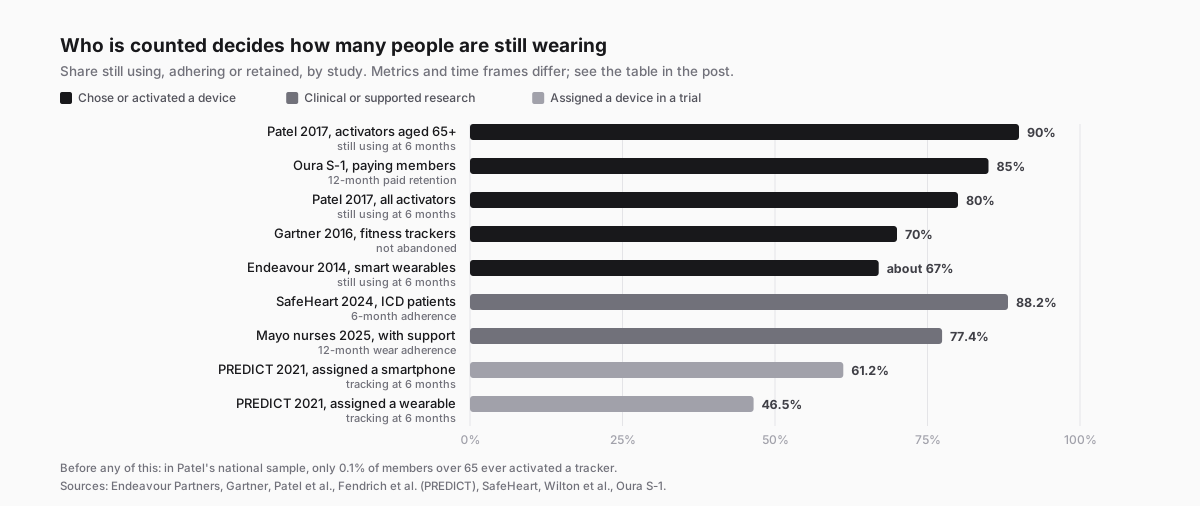
| Source | Who was counted | Result |
|---|---|---|
| Endeavour Partners, 2014 | 1,700+ consumers who owned smart wearables | About a third had abandoned within six months; about half of activity trackers in a 2013 survey [1] |
| Gartner, 2016 | 9,592 online consumers, US, UK, Australia | 30% of fitness trackers and 29% of smartwatches ultimately abandoned [2] |
| Patel et al., Annals of Internal Medicine, 2017 | Members of a US wellness program, 2014 to 2015, who activated a tracker | About 80% still using at six months [3][4] |
| Fendrich et al., Scientific Reports, 2021 (PREDICT trial) | 442 patients discharged from hospital, randomised to wearable or smartphone | 46.5% of wearable users and 61.2% of smartphone users still sending data at six months [5] |
| SafeHeart, European Heart Journal Digital Health, 2024 | Patients with implantable defibrillators | 88.2% adherence over six months [6] |
| Wilton et al., Clinical and Translational Science, 2025 | 298 Mayo Clinic nurses with heavy support | 77.4% average wear-time adherence over 12 months [7] |
| Rock Health, December 2025 | 8,000 US adults; wearable owners | 83% wear five or more days a week; 59% always or nearly always; 47% have used one for three years or more [8] |
| YouGov UK tracker, 2026 | British adults | 35% own and use a wearable; 10% own one but no longer use it [9] |
| Oura S-1, 2026 | Paying Oura members | About 85% weighted-average twelve-month paid retention [10] |
Why the numbers disagree
Three things separate the high figures from the low ones.
Choosing versus being given. People who bought a device, or activated one through a program they signed up for, keep using it at high rates: about 80% in Patel’s national sample [3], 85% retention among Oura’s paying members [10], and most of Rock Health’s owners wearing theirs nearly every day [8]. People handed a device as part of a study or a care pathway drop off faster: 46.5% still tracking at six months after hospital discharge [5]. The first group selected itself. The second is closer to the population a health program is trying to reach.
Support. Research cohorts with dedicated help, newsletters, replacement devices and charging stations hold adherence near 77% for a year [7]; clinical populations with a strong reason to comply reach 88% [6]. Those are achievable numbers, but they are what the support buys, not what a device does on its own. The Mayo study also found adherence was 9.1% lower for people who found the device uncomfortable and 5.4% higher for those who saw changes in their sleep or activity [7].
What “still using” means. Owning, wearing and sending data are three different things. YouGov’s 10% who own a wearable but no longer use it would be counted as owners in many surveys [9]. A device worn during the day but never overnight produces activity data and no sleep data. A device worn but not synced produces nothing a program can see. We covered what reaches a backend and when in why wearable data is late.
The biggest drop happens before day one
The most useful number in Patel’s study is not the 80%. It is the activation rate. Among the wellness program’s members over 65, only 0.1% ever activated a tracker. Of the older adults who did activate one, 90% were still using it six months later, a higher rate than younger groups [3][4]. Other studies also find older age associated with better long-term adherence [6].
That reframes the abandonment question. For many of the people health programs are designed for, the problem is not that they stop wearing the device. It is that they never start. A six-month retention figure computed on the people who activated says nothing about the people who didn’t, and in most populations that is the majority. We examine the over-65 case in detail in wearables and adults over 65.
Who stops first
The PREDICT trial went further than a single retention rate. It classified patients into behavioural phenotypes and followed each group. People who were more agreeable and conscientious, or more active, social and motivated, kept tracking at similar rates whether they had a wearable or a smartphone. People who were more risk-taking and less supported, or less active and less social, were more likely to stop using a wearable than a smartphone [5].
Those at-risk groups are the ones most chronic-care and wellness programs exist for. The device that measures more is also the device they are most likely to abandon, and the phone is the tracker they are most likely to keep.
The survivorship problem this creates
Abandonment is not only an engagement metric. It changes what the data says.
If the people who stop wearing first are less healthy, less supported or less motivated, then a long-running wearable dataset gradually describes a healthier, more engaged population than the one that started. Average step counts rise, resting heart rate falls and sleep improves, partly because the people with the worst numbers are no longer in the denominator. Program reports that show improvement over six months without accounting for who left are showing some of that. The randomised trials of workplace wellness found exactly this selection at enrolment [11]; abandonment adds it again over time.
For models trained on long-term wearable data, the same bias applies: the training population is the people who kept wearing the device.
What this means for programs built on wearables
1. Measure the funnel, not one retention number. Report eligible people, those who connected a device, and those still sending data at 30, 90 and 180 days, by monthly cohort. The first step is usually the biggest loss. We laid out a full scorecard in wellness program KPIs.
2. Separate ownership, wear and transmission. Define a valid day by wear time, not by whether a device is registered. Research using Fitbit data in the All of Us program treats 10 or more hours of wear as a valid day for activity estimates [12].
3. Track who leaves. Compare the baseline health and engagement of people who stop with people who stay. If they differ, report outcomes with that in mind.
4. Let people keep participating without the device. Accepting phone data as well as wearable data means that forgetting to charge a watch, or giving it up, does not remove someone from the program. In the PREDICT trial the phone retained more people at six months [5], and it retains the at-risk groups best. The phone records steps, movement and sleep timing without a wearable.
5. Design against the known reasons. Usefulness, comfort, charging and intrusiveness predict adherence [2][7]. Showing people changes in their own sleep or activity is the one factor consistently associated with better adherence. Consumer app retention follows similar patterns, covered in why most health app users churn.
Where we sit
Sahha reads data from wearables and from the phone, so we are not neutral about the conclusion that follows. But the published evidence supports it independently. A program that only counts wearable data is measuring the people who started and stayed. Counting the phone keeps the people who never started, or stopped, in view.
The short version
The widely quoted figure is that a third of people abandon their wearable within six months, and surveys since have found roughly the same. But studies disagree by who they count: about 80% of people who activate a tracker in a wellness program still use it at six months, and 85% of Oura’s paying members renew, while only 46.5% of hospital patients given a wearable are still tracking at six months, against 61.2% with a phone. Support raises adherence to 77% to 88%. The largest loss happens before anyone starts: in one national sample, 0.1% of adults over 65 activated a tracker, though 90% of those kept going. The people most likely to stop are the ones programs most want to reach, which biases long-term wearable data toward the healthy.
References
- Endeavour Partners’ Consumer Behavior Study Points to Uncertain Future of Wearable Devices. GlobeNewswire, August 2014; and Survey: One third of wearable device owners stopped using them within six months, MobiHealthNews. https://www.globenewswire.com/news-release/2014/08/15/1060135/0/en/endeavour-partners-consumer-behavior-study-points-to-uncertain-future-of-wearable-devices.html and https://www.mobihealthnews.com/news/survey-one-third-wearable-device-owners-stopped-using-them-within-six-months
- Fitness Tracker Abandonment Rate: 30%; Smartwatch, 29%. MediaPost, 9 December 2016, reporting Gartner’s survey; and Smartwatch user dropout rate is still 29%, Gartner says, Computerworld. https://www.mediapost.com/publications/article/290631/fitness-tracker-abandonment-rate-30-smartwatch.html and https://www.computerworld.com/article/1681349/smartwatch-user-dropout-rate-is-still-29-gartner-says.html
- Patel, M.S. et al. Using Wearable Devices and Smartphones to Track Physical Activity: Initial Activation, Sustained Use, and Step Counts Across Sociodemographic Characteristics in a National Sample. Annals of Internal Medicine, 2017. https://www.acpjournals.org/doi/10.7326/M17-1495
- 80 percent of activity tracker users stick with the devices for at least six months, study shows. ScienceDaily, 26 September 2017; and Use of Activity Trackers by Low-Income and Elderly, University of Pennsylvania Almanac. https://www.sciencedaily.com/releases/2017/09/170926091700.htm and https://almanac.upenn.edu/articles/use-of-activity-trackers-by-low-income-and-elderly
- Fendrich, S.J., Balachandran, M. and Patel, M.S. Association between behavioral phenotypes and sustained use of smartphones and wearable devices to remotely monitor physical activity. Scientific Reports, 11, November 2021. https://pmc.ncbi.nlm.nih.gov/articles/PMC8563736/
- Long-term adherence to a wearable for continuous behavioural activity measuring in the SafeHeart implantable cardioverter defibrillator population. European Heart Journal Digital Health, 5(5), 2024. https://academic.oup.com/ehjdh/article/5/5/622/7725535
- Wilton, A.R. et al. Participant-Centered Engagement for Sustained Adherence to Smartwatches: A 12-Month Prospective Decentralized Digital Health Study. Clinical and Translational Science, 2025. https://pmc.ncbi.nlm.nih.gov/articles/PMC11829698/
- What’s your score? Insights on wearables and connected devices from Rock Health’s 2025 Consumer Adoption Survey. Rock Health, 2026. https://rockhealth.com/insights/whats-your-score-insights-on-wearables-and-connected-devices-from-rock-healths-2025-consumer-adoption-survey/
- Brits’ use of wearable devices, 2019 to 2026. YouGov tracker. https://yougov.com/en-gb/trackers/brits-use-of-wearable-devices-eg-a-smartwatch-or-wearable-fitness-band
- Oura Inc., Form S-1, filed 3 September 2026. https://www.sec.gov/Archives/edgar/data/2133022/000119312526381855/d119865ds1.htm
- Jones, D., Molitor, D. and Reif, J. What Do Workplace Wellness Programs Do? Evidence from the Illinois Workplace Wellness Study. Quarterly Journal of Economics, 2019. https://www.nber.org/programs-projects/projects-and-centers/workplace-wellness/illinois-workplace-wellness-results
- Fitbit Physical Activity and Sleep Data in the All of Us Research Program: Data Exploration and Processing Considerations for Research. Medicine and Science in Sports and Exercise, 2025. https://pubmed.ncbi.nlm.nih.gov/40605186/