Short answer: a smartwatch can flag signs of moderate-to-severe sleep apnea. It cannot diagnose it, and it misses a meaningful share of people who have it.
Two consumer features have FDA authorization. Samsung’s came first, in February 2024, through the De Novo pathway [3]. Apple’s followed in September 2024 as a 510(k), using Samsung’s feature as its predicate [1]. Both are over-the-counter, both are for adults who have never been diagnosed, and both say plainly that the absence of a result is not the absence of disease.
They are also built differently, validated differently and good at different things. This post walks through what each one measures, what the FDA studies actually showed, why the numbers move so much with who is tested, and what a notification should set in motion. That last part is the one that matters for health plans, sleep providers and anyone building a product on top of a notification.
Why does this matter now?
Sleep apnea is common, mostly undiagnosed, and newly expensive to ignore.
A 2019 analysis estimated that 936 million adults aged 30 to 69 worldwide have obstructive sleep apnea, 425 million of them moderate to severe, with the US second only to China in absolute numbers [5]. In the Wisconsin Sleep Cohort, moderate-to-severe sleep-disordered breathing affected 10% of men aged 30 to 49 and 17% of men aged 50 to 70, and 3% and 9% of women in the same bands [6]. An analysis commissioned by the American Academy of Sleep Medicine put US prevalence at about 29.4 million adults, nearly 80% undiagnosed, at an annual cost of about $150 billion [7].
Two things changed the economics of finding those people. In December 2024 the FDA approved tirzepatide (Zepbound) as the first medication for moderate-to-severe obstructive sleep apnea in adults with obesity [8]. Medicare Part D plans can cover it for that indication, although weight loss alone remains excluded, which makes a documented diagnosis the gate to a drug benefit [9]. And CPAP coverage has always required a qualifying test result [10]. A diagnosis is now the entry point to two reimbursable treatment paths, and the watch on the wrist is the cheapest place to start looking.
How does Apple Watch detect sleep apnea?
Apple’s Sleep Apnea Notification Feature uses the accelerometer, not blood oxygen. While the user sleeps, it estimates breathing disturbances, small transient changes in breathing such as brief interruptions, and classifies each night as elevated or not elevated [1][2].
It then looks at 30-day windows. If the pattern is consistent with moderate-to-severe sleep apnea within a window, the user gets a notification. It runs passively once turned on. Apple’s support page says it needs at least 10 nights of wear in each 30-day window and works on Series 9 and later, Ultra 2 and later, and SE 3, for adults 18 and over without a prior diagnosis [2].
The validation. Apple enrolled 1,499 adults across several US sites and compared the feature against a home sleep apnea test (the Nox T3s), using the 4% hypopnea scoring rule. 1,278 contributed to the notification analysis [1].
- Sensitivity 66.3% (95% CI 62.2% to 70.3%) for moderate-to-severe sleep apnea (AHI 15 or more).
- Specificity 98.5% (95% CI 98.0% to 99.0%) for people below that threshold.
- No false notifications at all among people with a normal result (AHI under 5).
The development data covered normal, mild, moderate and severe categories, and the study enrolled against targets for age, sex, BMI, skin tone, race and ethnicity; Apple reports that performance was similar across subgroups [1].
How does the Samsung Galaxy Watch detect sleep apnea?
Samsung’s Sleep Apnea Feature uses blood oxygen estimated from the watch’s optical sensor. It looks for repeated relative drops in oxygen within one-minute windows, counts them into an estimated apnea-hypopnea index, and compares each night with a threshold of 15 events an hour [3].
It is on demand, not passive. The user starts an assessment, and it needs two qualifying nights within 10 days. A night with less than three hours of sleep or less than 70% oxygen coverage returns insufficient data. Only if both nights come back at 15 or more does it report signs of moderate-to-severe obstructive sleep apnea [3]. It is for adults 22 and over.
The validation. Samsung’s study enrolled 620 adults at accredited sleep labs, with 470 in the analysis, each wearing the watch through two nights of in-lab polysomnography scored by a physician [3].
- Sensitivity 82.7% (167 of 202), 95% CI 76.7% to 87.6%. This passed the pre-specified criterion.
- Specificity 87.7% (235 of 268), 95% CI 83.1% to 91.4%. This did not pass the pre-specified criterion.
- A post-hoc analysis found that 23 of the 33 false positives had at least one night of moderate-to-severe apnea on polysomnography, and 10 of them had previously undiagnosed mild sleep apnea. Counting those 10 as benefiting raised specificity to 91.1% [3].
- 16.7% of nights returned insufficient data [3].
The FDA summary is also useful for its limits. The feature cannot detect central sleep apnea, and it is not for people with movement conditions such as Parkinson’s, cardiac conditions such as atrial fibrillation or heart failure, or lung conditions such as COPD, nor during pregnancy or temporary breathing problems [3]. Performance in darker skin tones (Fitzpatrick 5 and 6) was 87.5% sensitivity and 90.9% specificity, no worse than the overall figures, which matters for an oxygen-based feature given how optical sensors behave on darker skin [3].
Why the numbers are not a head-to-head comparison
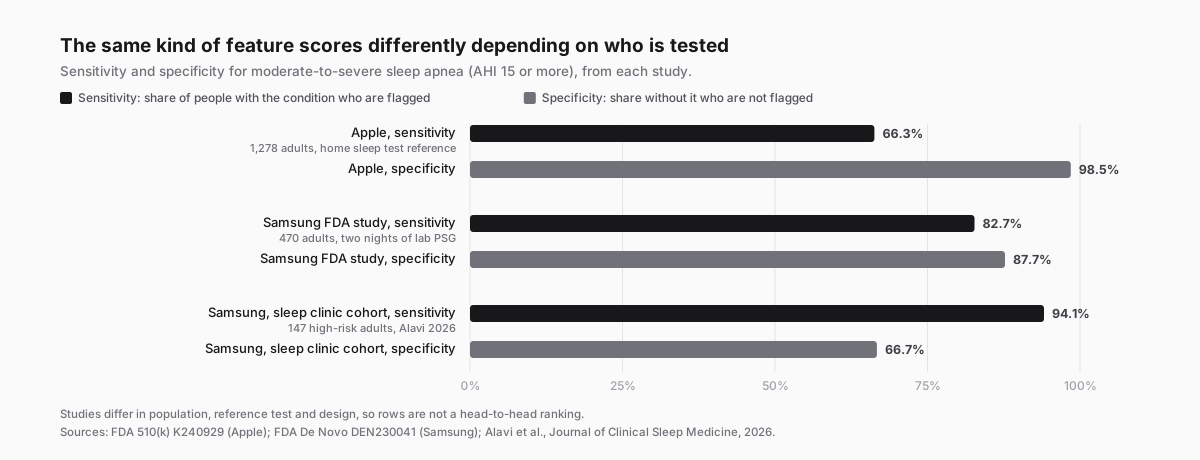
It is tempting to read the chart as “Samsung catches more, Apple is more precise.” That is roughly the trade-off each design chose, but the studies are not comparable enough to rank.
- Different reference tests. Apple compared against a home sleep test; Samsung against in-lab polysomnography with physician scoring [1][3].
- Different populations. Samsung’s study was enriched with people likely to have sleep apnea. Apple’s enrolled across the severity spectrum, with 559 normal and 362 mild participants alongside 417 moderate or severe [1][3].
- Different designs. Apple notifies passively after a 30-day window. Samsung returns a result after two nights the user chose to test.
A 2026 study in the Journal of Clinical Sleep Medicine shows how much population and threshold move the numbers [4]. Alavi and colleagues tested the Galaxy Watch in 147 adults who either had moderate-to-severe apnea already or scored high on a screening questionnaire. At Samsung’s default threshold the watch caught 94.1% of moderate-to-severe cases but correctly cleared only 66.7% of the rest. Raising the threshold to 26 events an hour flipped the balance to 82.4% sensitivity and 94.9% specificity. The area under the curve was 0.94. Same watch, same algorithm, very different operating points.
What about rings and mattress sensors?
The same physiology is reachable from other devices, under different regulatory positions.
- Oura Ring 5 shows a rolling 30-day view of nighttime breathing patterns and disturbances as part of Health Radar. Oura presents it as a wellness feature, not an FDA-authorized notification or a diagnosis [11]. The smart ring market map covers the device.
- Withings Sleep Rx, an under-mattress sensor, received FDA 510(k) clearance in September 2024 as a prescription device to aid in the diagnosis of obstructive sleep apnea at home [12]. That is a different category from both watches: prescribed, and intended to support a diagnosis rather than to prompt one.
The distinction is the one the FDA’s January 2026 wellness guidance draws around intended use. A feature that names a disease is a device claim; one that reports breathing patterns for general wellness may not be. The same sensor can sit on either side of that line. Is your health app a medical device? covers where the line now sits.
What a notification should trigger
A watch notification is the top of a funnel, not the end of one. For a health plan, a sleep provider, a DME supplier or an employer, the value is in what happens next.
| Step | What it takes | Who usually owns it |
|---|---|---|
| Notification | Apple or Samsung feature on the member’s own watch | The member |
| Clinical conversation | A visit that documents symptoms and risk | Primary care or a sleep telehealth provider |
| Diagnostic test | Polysomnography, or a qualifying home sleep test | Sleep lab or home testing provider |
| Diagnosis | AHI 15 or more, or 5 to 14 with documented symptoms or conditions [10] | Treating clinician |
| Treatment | CPAP, oral appliance, surgery, or tirzepatide for adults with obesity [8] | Clinician, DME supplier, pharmacy |
| Adherence | CPAP use of at least 4 hours a night on 70% of nights in a 30-day period in the first three months [13] | Patient, supplier, clinician |
Three design points follow from the evidence.
Do not make your own sleep apnea claim. If your product infers apnea risk from raw oxygen or motion data and says so, you are making a disease claim that Apple and Samsung each needed FDA authorization to make. Surfacing a device’s own notification is different from generating one.
Treat silence carefully. A population with no notifications still contains people with moderate-to-severe apnea. Outreach programs that target only notified members should also use conventional screening, such as risk questionnaires and BMI, alongside it.
Measure conversion, not notifications. The metric that matters is how many notified members reach a diagnostic test and then treatment, and how many keep using it. The same point about outcomes over activity runs through wellness program KPIs.
Can an app read the data?
On iPhone, partly. HealthKit defines a sleep apnea event category type and an Apple sleeping breathing disturbances quantity type, both introduced in iOS 18 [14][15]. An app can request permission to read them like any other HealthKit type, which means a care-navigation or wellness app can react to a notification the user has already received.
Samsung’s feature does not expose its underlying data. The FDA summary states that no raw signal data, including the oxygen signal, is provided to the user or shared with clinicians [3]. On Android, blood-oxygen samples may still reach Health Connect from Samsung Health, but the apnea determination itself stays in Samsung’s app.
For the broader question of which sleep metrics survive the trip from a wearable to a product, and how, see the sleep tech market and why wearable data arrives late.
The short version
Apple and Samsung both have FDA authorization to flag signs of moderate-to-severe obstructive sleep apnea in undiagnosed adults. Apple’s uses motion, runs passively over 30 days, and in its study caught 66% of cases while almost never raising a false alarm [1]. Samsung’s uses blood oxygen over two on-demand nights and caught 83%, with more false positives, many of them people with milder sleep apnea [3]. Neither diagnoses anything, and neither rules it out. With a drug and CPAP both gated on a formal diagnosis, the useful product is the pathway from notification to test to treatment, not the notification itself.
References
- US Food and Drug Administration. 510(k) summary K240929, Sleep Apnea Notification Feature, Apple Inc., cleared September 2024. Predicate DEN230041. Clinical study of 1,499 enrolled adults against Nox T3s home sleep apnea testing. https://www.accessdata.fda.gov/cdrh_docs/pdf24/K240929.pdf
- Apple Support. Sleep apnea notifications on your Apple Watch. https://support.apple.com/en-us/120031
- US Food and Drug Administration. De Novo summary DEN230041, Sleep Apnea Feature, Samsung Electronics, February 2024. Regulation 21 CFR 868.2378, product code QZW. https://www.accessdata.fda.gov/cdrh_docs/reviews/DEN230041.pdf
- Alavi, A., Costa, E., Matsumoto, M. M. S., et al. (2026). Smartwatch-based detection of moderate-to-severe and high-risk obstructive sleep apnea. Journal of Clinical Sleep Medicine. https://doi.org/10.1007/s44470-026-00159-8
- Benjafield, A. V., Ayas, N. T., Eastwood, P. R., et al. (2019). Estimation of the global prevalence and burden of obstructive sleep apnoea: a literature-based analysis. The Lancet Respiratory Medicine, 7(8), 687 to 698. https://doi.org/10.1016/S2213-2600(19)30198-5
- Peppard, P. E., Young, T., Barnet, J. H., Palta, M., Hagen, E. W., & Hla, K. M. (2013). Increased prevalence of sleep-disordered breathing in adults. American Journal of Epidemiology, 177(9), 1006 to 1014. https://doi.org/10.1093/aje/kws342
- American Academy of Sleep Medicine and Frost & Sullivan. Hidden Health Crisis Costing America Billions. 2016. https://aasm.org/resources/pdf/sleep-apnea-economic-crisis.pdf
- US Food and Drug Administration. FDA Approves First Medication for Obstructive Sleep Apnea. 20 December 2024. https://www.fda.gov/news-events/press-announcements/fda-approves-first-medication-obstructive-sleep-apnea
- Sleep Foundation. Does Medicare Cover Zepbound for Sleep Apnea? https://www.sleepfoundation.org/sleep-apnea/does-medicare-cover-zepbound-for-sleep-apnea
- Centers for Medicare & Medicaid Services. National Coverage Determination 240.4, Continuous Positive Airway Pressure (CPAP) Therapy for Obstructive Sleep Apnea. https://www.cms.gov/medicare-coverage-database/view/ncd.aspx?ncdid=226
- TechCrunch. Oura unveils its Ring 5 with a thinner, lighter design starting at $399. 28 May 2026. https://techcrunch.com/2026/05/28/oura-unveils-its-ring-5-with-a-thinner-lighter-design-starting-at-399/
- US Food and Drug Administration. 510(k) K231667, Withings Sleep Rx, cleared September 2024. https://www.accessdata.fda.gov/cdrh_docs/pdf23/K231667.pdf
- Centers for Medicare & Medicaid Services. Local Coverage Determination L33718, Positive Airway Pressure (PAP) Devices for the Treatment of Obstructive Sleep Apnea. https://www.cms.gov/medicare-coverage-database/view/lcd.aspx?LCDId=33718
- Apple Developer. HKCategoryTypeIdentifier.sleepApneaEvent. iOS 18.0 and later. https://developer.apple.com/documentation/healthkit/hkcategorytypeidentifier/sleepapneaevent
- Apple Developer. HKQuantityTypeIdentifier.appleSleepingBreathingDisturbances. iOS 18.0 and later. https://developer.apple.com/documentation/healthkit/hkquantitytypeidentifier/applesleepingbreathingdisturbances